Mathing Out Aurora


The Math behind Aurora
Aurora is the cool new payoff card in Marvel Snap. Payoff for what? Everything!

On Reveal: Give one of your other On Reveal cards at each location +2 Power. Repeat for Ongoing, Activate, and End of Turn.
How does she actually work?
She is not a blanket +2 to everything with a keyword. She grants extra power to ONE On Reveal card at each location. Meaning, if you have two or three On Reveals at a location, she will only give +2 to one of them. Then she does the same for the other keywords. So, what you're trying to do is have a mix of keywords at each location.
Aurora Math
Just how big can she get? How realistic is her ceiling? What is an acceptable floor? What numbers can you expect in a competitive ladder deck? What totals are possible in the meme-iest of clip farming decks? Let's take a look at the math surrounding Aurora.
Cards that can get +4

There are only four of these, but it's pretty obvious what pops out. Aurora is definitely a Thanos card, but is she more?
Cheap Cards that get +2
| Keyword | Cards |
|---|---|
| End of Turn | Sunspot, Black Cat, Hydra Bob |
| Activate | Araña, King Eitri, Spider-Ham |
| Ongoing | Howard the Duck, Ebony Maw, Quinjet, Ant-Man |
| On Reveal | Iceman, Korg, Elektra, America Chavez, Nico Minoru |
| Non 1-Cost cards | Yellowjacket, Evolved Wasp, Cap's Shield, Makkari |
Above are some of the most promising, inexpensive pieces for an Aurora deck. On Reveal is so common, you're not going to struggle to find good pieces that fit your deck. Activate and End of Turn are the rarer traits. They'll be at more of a premium when building an Aurora deck. This means cards like Herbie and Adam Warlock might get a little more consideration than they otherwise would in the 2-Cost slot.
Aurora is a 6-Cost Card that spreads power across the board on turn 6. We've had those before.
| Minimum | Expectation | Theoretical Max | |
|---|---|---|---|
| Doctor Doom | 15 | 15 | 15 |
| Spectrum | 7 | 21 | 29 |
| Aurora | 6 | 22 | 30 |
Doctor Doom is always the same, reliable output, assuming there is board space. If you get him off the Raft or whatever, Doom is clearly far better than the other two, though Aurora is likely to be much better than Spectrum for most decks in this situation.
The “high expectation” for Spectrum is based on buffing one full lane and one lane of three, for a total of seven buffs. If you've played a lot of Spectrum, you know that sounds achievable and would represent a good, solid game from your deck. The expectation for Aurora is based on buffing eight cards, which I think is a good expectation based on the play lines I've run through with the decks I've theory-crafted. It's clear that the one point separation of Spectrum at 6/7 and Aurora at 6/6 is actually pretty important.
The theoretical maximums are based on playing them into a full board of 11 cards. These can obviously be much higher if you add cards like Wong or Odin into the mix (we'll talk about some high shenanigans later).
The difference in power level between Spectrum and Aurora will rely on two features. First, Spectrum really can't get much closer to its “theoretical maximum.” There just aren't enough low-cost Ongoing cards to be buffing more than seven reliably. Aurora on the other hand, could get above eight buffs occasionally, if that's what a deck is built towards doing, thanks to more low-cost options. Second, and I think the crucial reason that Aurora has a chance to be better than Spectrum, an Aurora deck has access to a much wider range of cards instead of just having to rely entirely on one keyword, which can be turned off.
Shenanigans Aurora
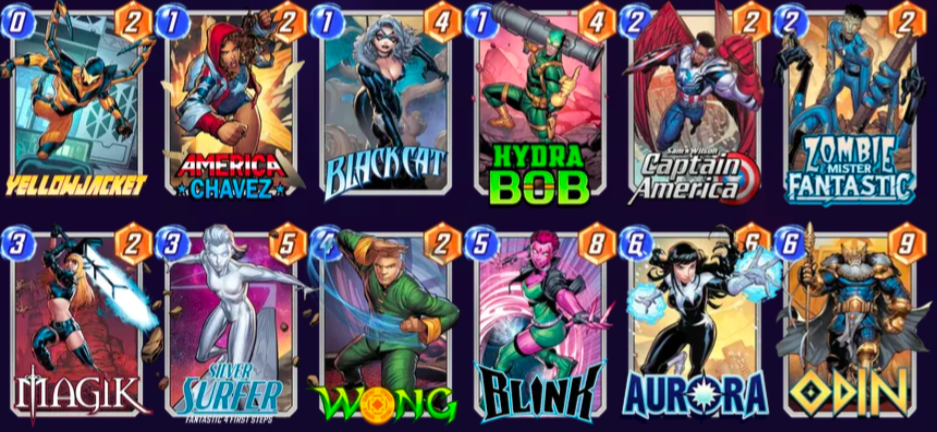
I promised shenanigans. With this deck, what is the maximum possible output? With the following play-by-play, you would end up with the board state below.
| Turn | Cards |
|---|---|
| 1 | Yellowjacket (can be played anytime, of course), Chavez |
| 2 | Sam Wilson |
| 3 | Magik |
| 4 | FS Silver Surfer, Black Cat |
| 5 | Wong, Bob |
| 6 | Aurora |
| 7 | Odin |
| Left | Middle | Right |
|---|---|---|
| Yellowjacket | First Steps Surfer | Chavez |
| Sam Wilson | Wong | Shield |
| Black Cat | Aurora | Magik |
| Odin | Bob |
This would give us 12 Aurora procs (or 8 procs if FS SS went off only on Turn 6 instead of 6 and 7 and copied Aurora's text). We'd have up to 80 Points left, 70 mid, and 80 right. Obviously, this isn’t an entirely realistic play line. But it does show Aurora’s theoretical top end and could definitely be prey for a dedicated clip hunter! Let’s take a look at a more realistic scenario.
Here's roughly the type of deck we might expect Aurora to slot into. Let's break down the expectations for a deck like this.
First Pass Thanos Aurora
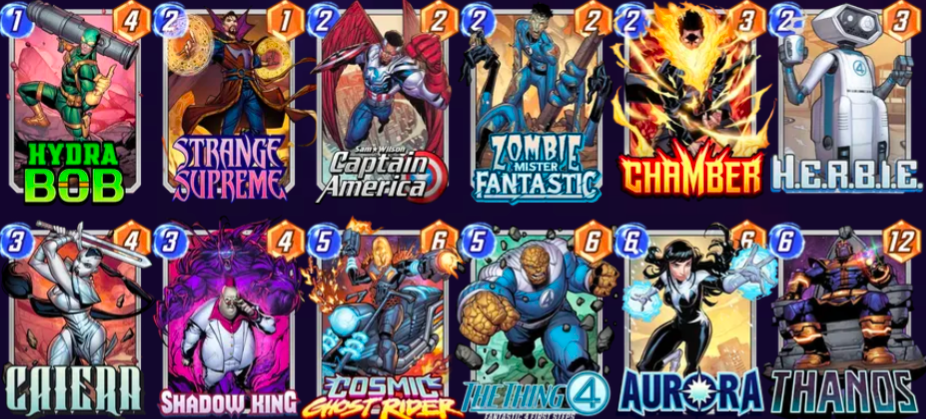
I think it's reasonable to have games where you buff 6-8 cards which would be 12-16 Power in buffs.
Here is a potential, realistic final board state for the deck.
| Left | Middle | Right |
|---|---|---|
| Mind Stone | Soul Stone | Time Stone |
| Caiera | Thanos | Space Stone |
| Hyrda Bob | Cap's Shield | Aurora |
This gives us 15 Power left, 15 middle, and 13 right, hardly anything to write home about in modern Marvel Snap. This board state doesn’t represent the best game for the deck. I didn’t get Chamber down. I played out Caiera – maybe I suspected my opponent had Killmonger. I wasn’t able to play all six stones. The shield provided no value by being in a lane with other Ongoings and not getting hit with a buff. But it is a game you can imagine having and helps push you away from thinking about Aurora only in the ideal situation and gives a realistic view of how she might play in a Thanos deck. You’re not going to just roll up with a Thanos/Aurora deck with no tricks or features and roll through the competition. It’s a baseline from which I hope you can imagine both better and worse games and different play lines. It stresses the need to get a lot of cards onto the board.
From a mathematical standpoint, Aurora can surpass Spectrum and will attack all three lanes harder than Doctor Doom in a deck built around her. If she's actually better in Thanos than Spectrum, it's not by much. If Thanos is the only competitive place for Aurora, I wouldn't be entirely surprised, but I am hoping there are more decks in which she can find success as a new build-around card.
The section below is exclusive to paid supporters of any tier. It includes eight more deck lists in directions I think are possible with Aurora to help get your creative juices flowing. If you're interested in the new card beyond the mathematical analysis above, consider subscribing today to see the deck lists. This type of article takes me a lot more time than a traditional card preview and our Supporters and Champions make it possible. Your support helps Lauren and I put out more, high-quality Marvel Snap content and your support really means a lot to us.